
Being 60 in France used to be the age at which you retire. End of the road, thanks for your service. Fortunately that limit doesn’t apply to businesses. One of them turns 60 next year. It’s the #2 player in its industry and serves 80 million customers daily. The name is Sodexo. Long a darling of the French market, its stock price is down 30% over 6 months, and trades at similar levels as 10 years ago.
I think it’s compelling today for the following reasons :
1/ The business and its capital structure have been simplified greatly over the last 18 months ;
2/ Outsourcing trend remains intact and the industry structure favours bigger players ;
3/ The management implements a playbook à la Compass which has been successfully proven ;
4/ Rebased expectations have impacted valuation recently and makes current price attractive.
Let’s dive deeper into that company.
A bit of history
The 70s saw the international expansion of the group, first in Europe (Spain, Italy…), then Africa and the Middle East. It’s also the beginning of the voucher business through “Chèques services” in Belgium (“Tickets restaurant” were launched in the early 80s in France).
In 1983, the company went public and started a new segment, live events hospitality, in 1987. This segment is now called Sodexo Live and represents c10% of sales.
Sodexo really became a behemoth during the 90s. At that time it made several acquisitions, particularly in the US, enabling it to take the leading spot in the industry. Acquisitions are a key feature of the industry due to the very nature of its competitive structure as we’ll see below. The expansion strategy, a mix of organic growth and M&A continued throughout the 00s and 10s.
50 years after founding Sodexo, Pierre Bellon retired from his chairman role in 2016 (he stepped down as CEO in 2005). Sophie Bellon, one of his daughters, took the chair. The Bellon family held c40% at the time, c43% today (58% of voting rights). Denis Machuel became CEO in 2018 after Michel Landel, who succeeded Pierre Bellon, retired. Between 2005 and 2018, Sodexo’s revenue grew from 11bn€ to 21bn€.
Machuel’s tenure (2018-2021) wasn’t really smooth. Of course Covid struck, but lingering issues particularly in the US, and a slow transformation led to frustration among investors. It led to his early departure – officially a “mutual agreement”, but we can all guess what it is about. Sophie Bellon took the CEO role right after. Initially it was supposed to be an interim role but it became permanent in March 2022.
That recent chapter is a big part of why the opportunity exists today. We’ll see that in more detail below. Let’s see first what Sodexo does today to get a clear picture.
What’s Sodexo about ?
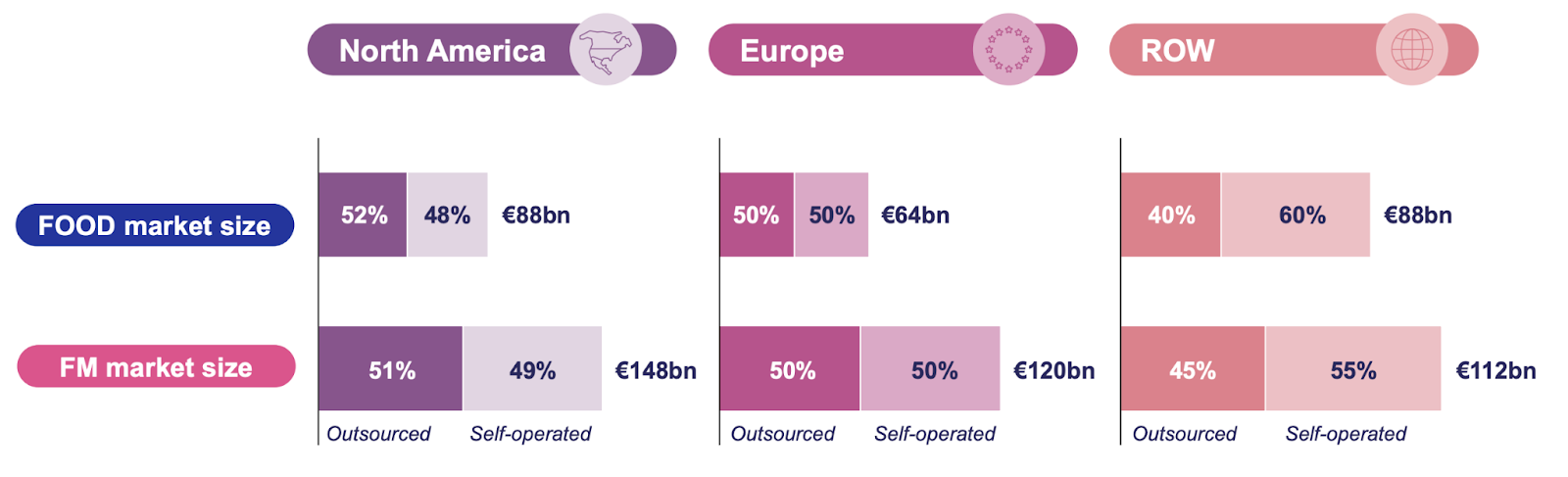
In FY2024 (fiscal year ending in August), Sodexo generated nearly 24bn€ of revenue. Half of that was made in North America, ⅓ in Europe and c20% elsewhere (China, India, Brasil, Australia…).
If we look a bit closer, we see that North America is mostly Food Services (>75%) vs Facility Management, while for Europe and Rest of World Food Services is slightly more 50% of revenue. Of course that affects the margin profile of these different regions : as Food Services has a better margin than FM, North America margin is better, between 5.5-6.0%, vs c4.0% for Europe and c4.5% for RoW.
Globally Sodexo is the #2 of its industry, behind Compass and its 40bn$+ of revenue. Bronze medal is for Aramark with 17bn$ (there were rumours of Sodexo taking it over a few months ago, but nothing concrete, for the best in my opinion). So a bit more than 25% of the market for these 3.
And then you have 2 other groups : 1/ Regional players, strong locally but lacking the scale of the 3 largest which have been gobbling them up for decades, and 2/ in-house operations, which have been a strong source of contract wins over time.
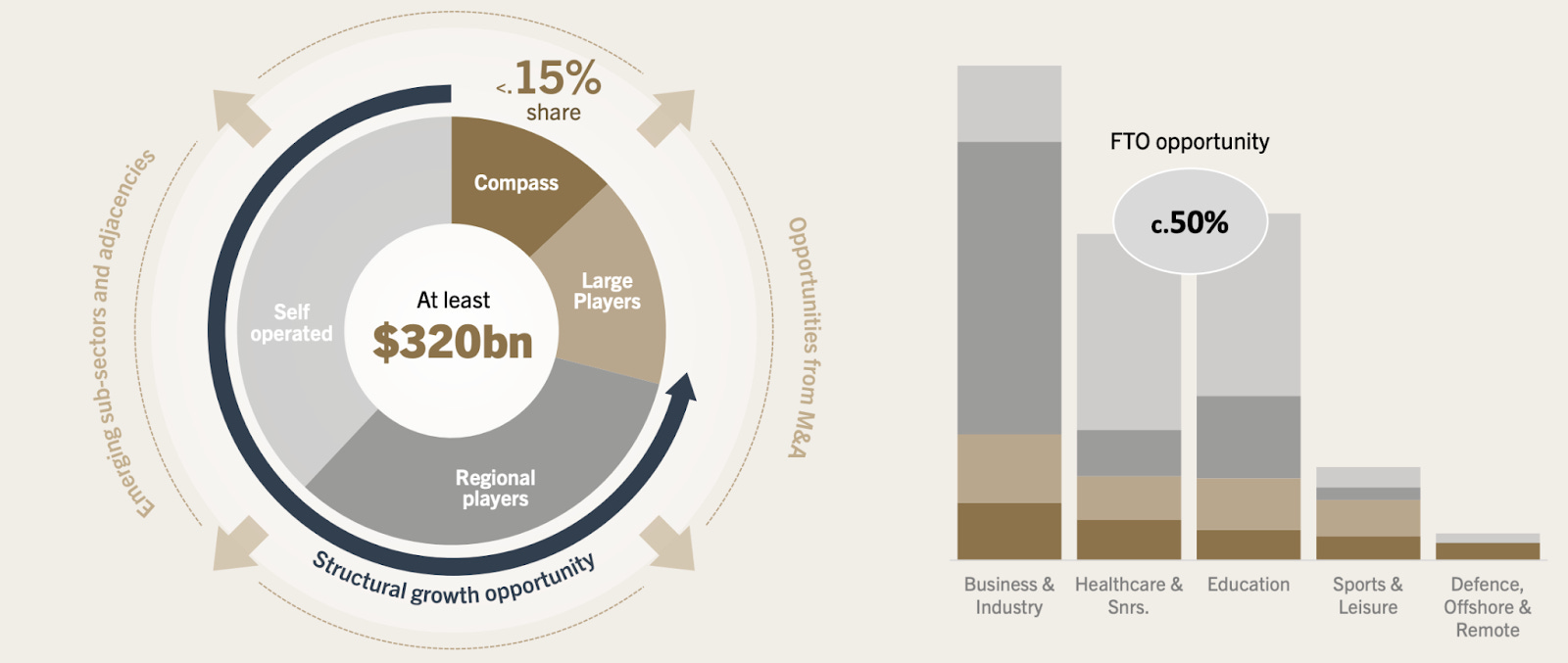
This is a really attractive industry structure with 2 persistent tailwinds.
First, more and more operations are outsourced. Why ?
1/ Bigger scale and efficient procurement enable lower prices and to be more cost competitive.
2/ For companies whose core business is not to run canteens, it makes no sense to try to earn money with an activity where things can be done more efficiently by a third party. This is just misallocation of capital.
3/ Complexity has increased recently with end consumers demanding personalized options (vegan, gluten etc). That is pertinent only if you have the scale.
Second, players relevant locally are acquired by bigger players. There are plenty of them, strongly recognized locally and which gain access to scale automatically when integrated to a bigger player, making them even more relevant.
Of course price increase and improved volumes also play a role in the industry growth. But pricing tends to follow inflation (you cannot increase prices above inflation over a long period of time when selling meals because of possible substitution), and volume strongly depends on the number of employees/patients/students of the place you operate in.
This means that the Food Services/Facilities Management industry (FS/FM) remains cyclical as it depends on the volume of clients ie employment. However we should note that organic growth was positive in 2008-09. This is due to one thing : outsourcing typically picks up at such times (in house is reduced). That kind of makes this business antifragile.
So how does it work really ? Well, let’s say you’re company ABC. You have a new building for your 1,000 employees. You want them to have lunch onsite – how generous ! You bring in Sodexo and ask them to operate the canteen on the ground floor. Based on what you want, they present you their offer and give you the option among 3 types of contracts (well, you usually already know what you want) :
1/ Fixed price (per meal) : ABC pays a fixed price per meal, Sodexo has to provide them with a meal that follows the specificities agreed upon, and control their cost to make a margin ;
2/ Cost plus : ABC pays the cost of making the meal plus pays a management fee to Sodexo (safer than fixed price) ;
3/ P&L Contracts : Sodexo and ABC share the profit earned on the operation.
Of course I say ABC pays, but it’s often not 100% of the price. Subsidy level depends on which company is involved.
Overall it means Sodexo and co have to satisfy 2 clients : 1/ the company in which premises it operates, and 2/ the final consumer, the eater, who can vote with his feet if the offer is not relevant. So there’s a double aspect, price and quality. And these are the main drivers of the retention rate : “the percentage of prior fiscal year revenue retained in this current fiscal year. It is derived by considering prior fiscal year value for all contracts for which termination has either been given by Sodexo or received by the client, or those that have expired without renewal.”
For Sodexo, the retention rate has been 94.2%, 95.2%, 94.5%, and 93.5% during the last 4 fiscal years. Compass, by comparison, posted rates of 96.0%, 96.5%, 96.4%, and 95.4%. There’s room for improvement at Sodexo though, of course, 100% retention is impossible (site closures, Sodexo voluntarily dropping a contract…). In this battle for keeping clients, incumbents are helped by one thing : switching costs for the client are important and changing your service provider can be riskier than just renewing your contract.
So here’s our final chain : Food growers → Distributors (Sysco, US Food…) → Sodexo client site → Prepared by Sodexo’s chefs → Food served to final client
Money flows in reverse, making Sodexo a negative working capital company. Although the level of receivables is different from one contract to another, depending on cash payment vs employer subsidy (ie do final client pay a part of meal or not?).
However, we should note that there are recurring Capex in order to get business (setting up a canteen once you win a contract or reshuffling it after a few years). It usually runs between 2.0 and 2.5% of sales. This brings us to a ROCE (operating profit / capital employed) above 15%. Not bad for a boring business.
Why is there an opportunity today ?
When Machuel arrived in 2018, Sodexo already faced challenges in the US. Just weeks after his arrival, Sodexo released a profit warning because of “weakness in North America, particularly in Health Care and Seniors”. -20% overnight.
Fast forward to 2022, November precisely. Machuel is out and Sophie Bellon is at the helm. She wants to act quickly. Investors had been seeing Sodexo as kicking the can down the road and not acting fast enough on business transformation/improvement. She doesn’t want that and presents her strategy at the Capital market day.
The US are a clear focus of the presentation. Ambitions are high. Really high. Over 10% organic growth per year for the following 3 years. Sarosh Mistry, in charge of North America, is confident : after all, his new package is based on the realisation of that target.
Three years later, organic growth was 13.9% and 8.7% for NA in 2023 and 2024 respectively. For 2025, Sodexo anticipated 5.5-6.5% for the whole group. Market cheered first, but then came January and its Q1 update. Group organic growth 4.6%, North America 5.9%. Well, a bit far from the initial guidance, isn’t it ? Investors weren’t at ease.
In late March came the profit warning : revenue growth revised down to +3-4%. Stock price : -20% to 60€. Two weeks later, Sodexo released its H1 results, and the stock price lost 10 additional percent. Enough for investors. Below 60€, the stock since then trades at multi year lows (except Covid period) : you’ve to go back to 2014-15 to see similar prices (adjusted for Pluxee’s spinoff). Classic “overpromise/underdeliver”.
How does it set the stage for a positive investment then ? Let me explain the 4 legs of it :
1/ Since arriving as CEO, Sophie Bellon has launched a simplification of the business. First, the spinoff of Pluxee (Benefits & Rewards Services) has been completed, making Sodexo a pure Food Services and Facility Management company.
Second, she has made multiple changes in the way Sodexo operates. Non core activities were divested where density, market share and profitability weren’t adequate. She decentralized the chain of command by transferring the P&L management to regions and the decision making to region/local level. The leadership team has also been reduced at the same time, and the retention rate is now a key KPI in the annual bonus (weird that it was not before).
Sodexo refocused on the Food Services segment – where the true money is – and is more selective on Facility Management – servicing only when it complements FS offer (ie need to be really accretive).
Finally, Sodexo increased its tech and data spend to 500m€ – driving better cost management and forecast – and made Entegra – its Group Purchasing Organization – a true profit center (it’s open to third parties, enabling them to gain access to economies of scale. More than 38bn€ of purchases in FY24).
More tech, more Food Services, decentralization… This is not something Sodexo thought of on its own, this is exactly the Compass playbook, the kind of organization that led them to get to an EBIT margin of 7%+, way ahead of Sodexo. In my opinion, it greatly improves their chances of success.
2/ The capital structure has been simplified too. Sodexo owned 100% of Sofinsod, which owned c20% of Bellon SA. Bellon SA is the family holding company owning 43% of Sodexo’s shares. Sofinsod indirectly owned c12.5m Sodexo shares. This cross-holding structure had long been criticized by investors, who had called for its simplification. Sophie Bellon did so in August 2024, selling Sofinsod back to Bellon SA for 918m€ ie c74€ per Sodexo share, a discount of <10% at the time. All the proceeds were paid back to shareholders in the form of a 6.24€ special dividend (390m€ paid to Bellon SA).
3/ The outsourcing and concentration trends remain intact. I mentioned the structure of the industry above so I won’t expand too much on that here. Just keep in mind that the development rate (the percentage of new revenue contracted) has been above 7% for 3+ years (including in H1 25). The net development rate has been >1.5% during the same period vs flat during 2017-19. With an industry structure favoring bigger players and concentration, and a remodeled organization, I expect that trend to continue with growth coming both organically and through M&A.
4/ The “overpromise/underdeliver” situation rebased expectations, impacted valuation recently and makes current price a good entry point. Sodexo today trades at a multiyear low in terms of valuation.
So what should we expect then ? What is it worth ?
The commercial trends of the next few quarters will give us a better grasp of the changes underway. I expect critical KPI like retention and new business to improve slightly. H2 25 guidance for retention is above 94%, still below the target of 95%, and well below the 96% of Compass. There’s room for improvement and most of it is probably self help.
Today Sodexo trades at a 10x PE NTM. Looking at a normalized FCF yield, it’s 8%. When you add the organic growth of the business 3-5%, you get a return of 11-13% per year. You directly earn part of it as Sodexo distributes 50% of earnings to shareholders in the form of dividend.
This is considering multiple doesn’t change. Sodexo’s earning multiple has been 18x on average over L10Y and 13x since the spinoff of Pluxee. We’re respectively 45% and 25% below right now.
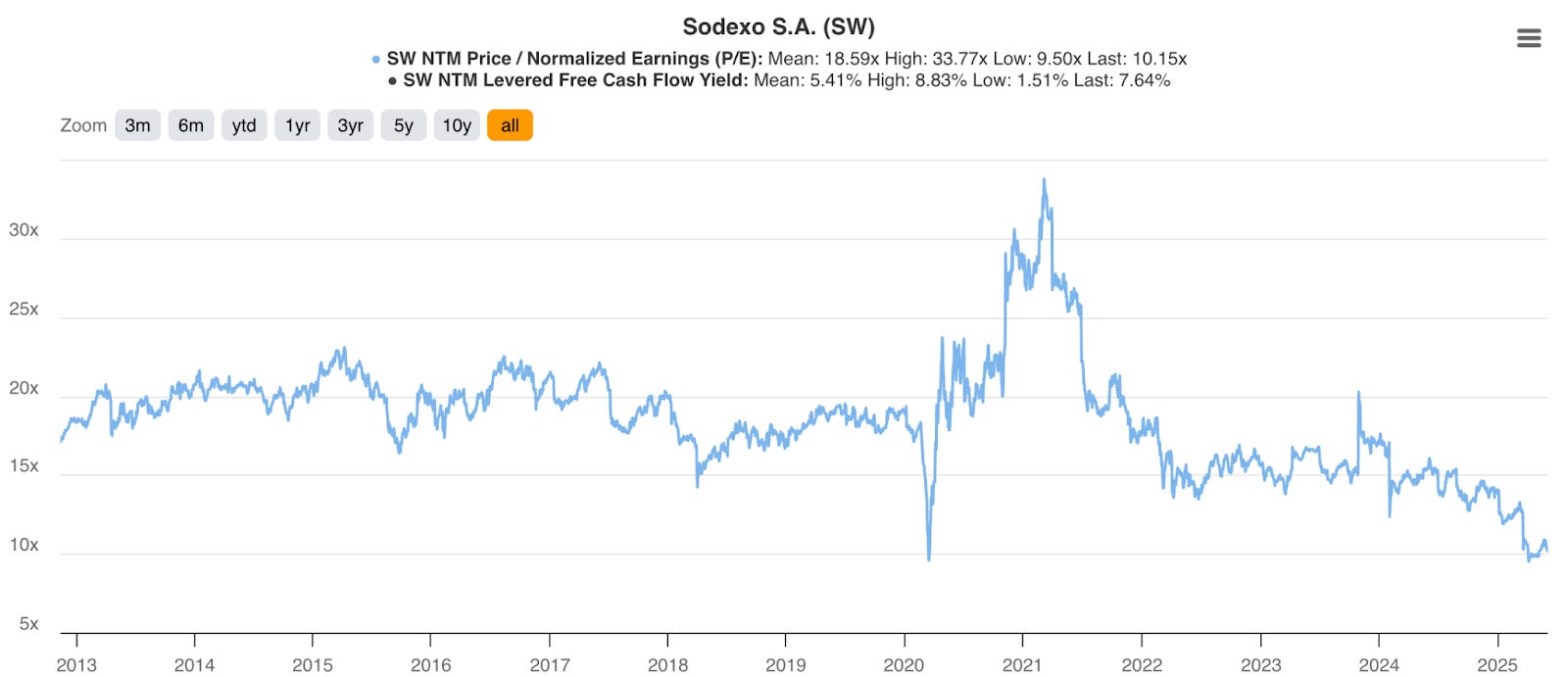
So LDD percentage return for a stable, recurring business, trading at a 10+ years low multiple (I know, the business is different than 10 years ago). Not bad. Once you start to factor in M&A and potential margin expansion (through refocus of the business and better use of technology), you can expect a couple more percent of return (+40bps in the yield when margin goes up 10bps with 3% revenue growth), going to c15%. Factor in multiple reaching 13x over N5Y, you get c20%. Given the nature and predictability of the business, at these rates, I own a position.
Is Sodexo being killed by Work from Home ?
5 years later, what can we say about that ? First, though some companies have been quite vocal about the end of their “work from home” policy, data show that WFH is here to stay as the following graphs from Torsten Slok show.
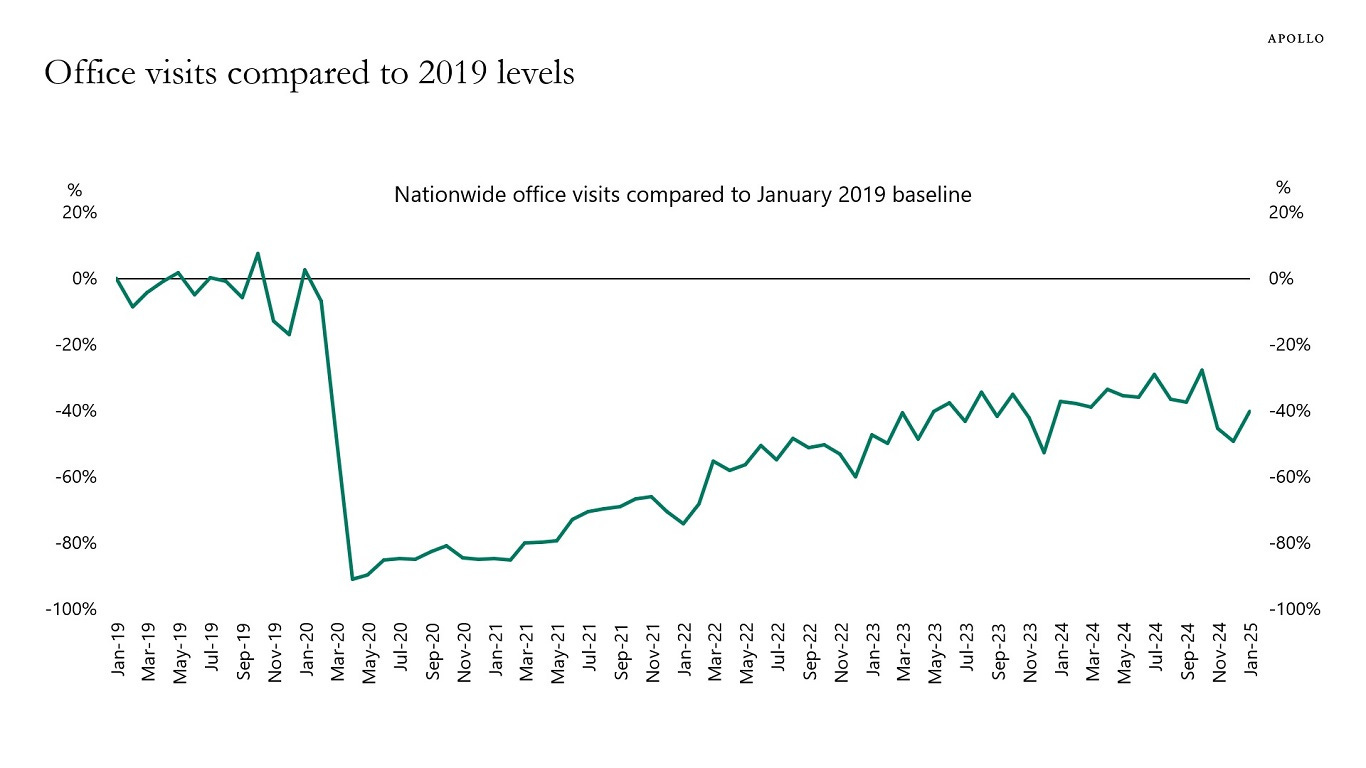
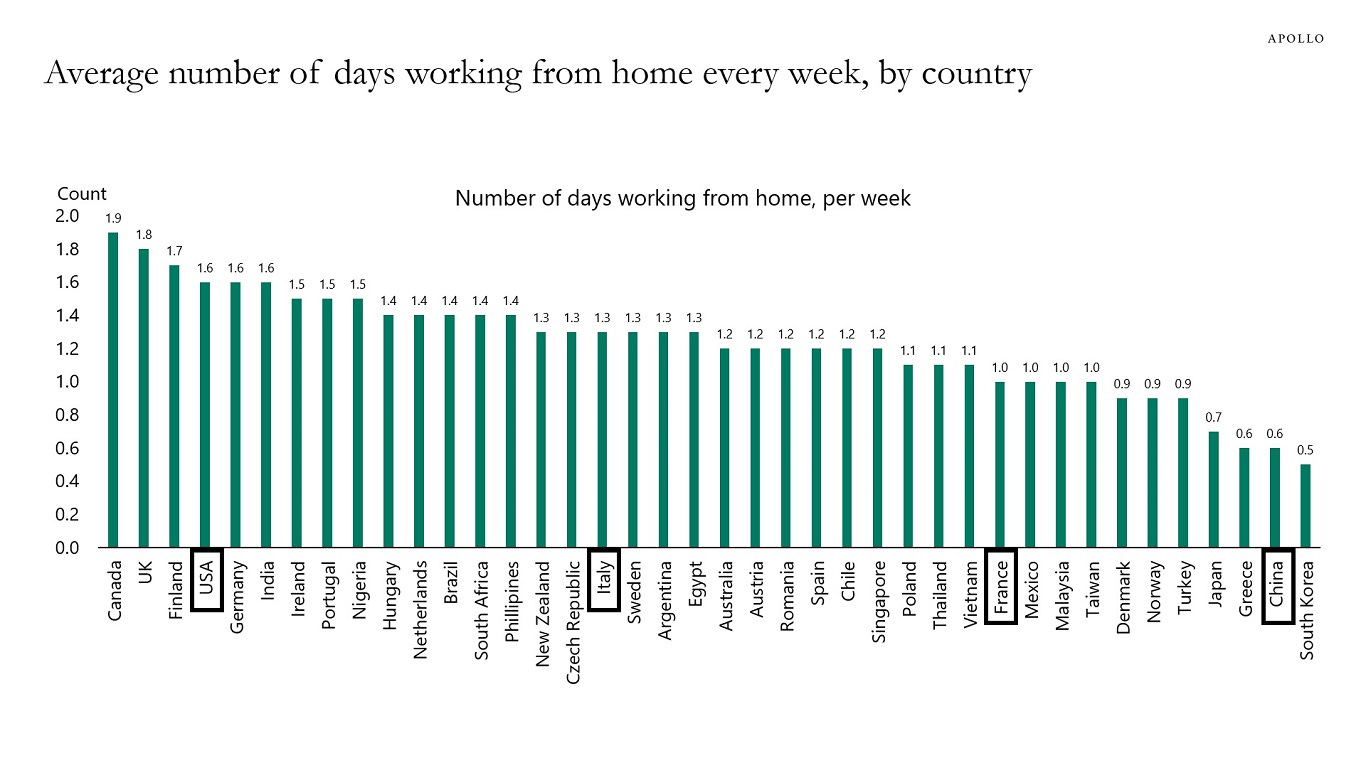
However, the whole industry figures have dramatically improved despite that tendency, proving their ability to adapt, both on the revenue and cost fronts.
Second, we should not overvalue the dependance of Sodexo on the white collar market. In North America, the Business & Administration segment is equally split between blue and white collar (CMD 2022). I don’t know the split for other geographies but if it’s also 50/50, then “WFH revenue” is <25% of total in FY24 and c27% if the split is 60/40.
5 years after Covid the industry has absorbed the WFH shock. We know it is here to stay, but not in the proportions initially feared, and definitely not risking one fifth of the industry revenue.
A word on Pluxee
Many investors have been and still are interested in Pluxee. I can understand why : revenue growth, high margin, reinvestment opportunities. From my point of view though, it’s a quick pass.
For most it’s impossible to invest in a company whose product you think is fundamentally wrong, think tobacco, betting, alcohol etc. For my part, I have a really low opinion of Ticket Restaurant and service vouchers. I think these are seen as employee benefits, when in reality it’s actual salary with spending strictly dictated. This isn’t a free-market policy, but a form of centralized economic planning — as if employees didn’t know how to spend their own money. And of course, this system feeds an entire ecosystem of companies like Pluxee or Edenred that charge outrageous commissions (3-5%), even though they shouldn’t even exist. Just give employees their salary directly — they know what to do with it !

0 Comments