
A few weeks ago, British Steel announced it was going to close its last blast furnace in the UK. Why ? “The blast furnaces and steelmaking operations are no longer financially sustainable due to highly challenging market conditions, the imposition of tariffs, and higher environmental costs relating to the production of high-carbon steel.” The transition to Electric Arc Furnaces happens everywhere. And you know what ? There’s someone who benefits a lot from that trend, Befesa.
This week I’m gonna talk to you about this Spanish-German stock, specialised in the recycling of steel dust.
The 60-second pitch
Befesa is the leader of the recycling of steel dust and aluminium salt slags. It operates in Europe and the US, and has a small presence in China. It trades at 23€ currently, I think it’s worth closer to 50€ over the next 3-5 years. I think it’s a BUY for the following reasons :
1/ Electric Arc Furnaces (EAF) are eating market share, generating more and more steel dust ;
2/ Highly regulated environment favouring incumbents and deterring competition ;
3/ Huge recent expansion not fairly priced in ;
4/ Historically low valuation while results are going to inflect.
Interesting, right ? If you’re curious, let’s dive a little deeper into Befesa.
Where does it come from ?
Metallgesellschaft created Berzelius Umwelt Service (BUS AG) in 1987, specialized in the treatment of industrial waste. In 1993, BUS AG merged its Spanish assets with other companies, becoming Berzelius Felguera SA, later Befesa. It became a subsidiary of Abengoa. In the following years, it acquired/developed multiple other plants in Germany, Korea, Turkey, France.
In 2013, it was acquired by Triton for 1.075bn€ (enterprise value). NB : Triton sold its last shares in 2019, and just repurchased a small stake in March 2025
In 2017, it IPOed on the Frankfurt Stock Exchange. 28€ per share, total market value c950m€, plus 400m€ of net debt.
In 2021, it acquired American Zinc Recycling (ex Horsehead) for 370m€ (450m$), mainly financed through the issuance of c6m shares (56€ per share).
What does Befesa do ?
Befesa is a key link in the steel and aluminium production chains. It operates through 2 segments : Steel Dust recycling services, and Salt Slags recycling services.
Let’s see the steel part first.
When producing steel with EAFs (Electric Arc Furnace), graphite electrodes are used to melt scrap steel (mostly), such that you get “new steel”. During that process, a byproduct is created : the steel dust. It is valuable because it’s rich in zinc.
The thing is that this dust is considered hazardous material in most countries. It means that you cannot just dump it anywhere you want, but you have to recycle it properly. This is where Befesa enters the game.
Befesa’s role is to collect the dust and recycle it. They either collect it themselves with their truck fleet, or receive it by rail. Here’s the first way they generate revenue : a service fee for collecting steel dust. On average, it’s c30% of the steel dust segment revenue.
Why wouldn’t EAFs owners do it themselves ? First you need a dedicated footprint for the recycling, a secondary activity vs the steel production. Second, you’d face regulatory scrutiny (think about the EU’s Waste Framework Directive or U.S. Resource Conservation and Recovery Act) that’s really tight : if the dust is not taken care of properly, regulation can make you stop steel production. Third you need to get enough volume to make it profitable : Befesa typically has 15 customers per kiln. All this makes direct operations by Befesa’s customers not economical.
These constitute strong barriers to entry. A new recycling plant requires multiple authorizations before opening, and they wouldn’t be given if current footprint is enough. Honestly, I think nobody would even try to get an approval because switching costs for customers are too important : you pay a small fee to Befesa for taking care of your dust, you know it’s done properly so you don’t risk seeing your operations being shut down. Why would you switch to another firm then ? The lower price wouldn’t counterbalance the higher risk of changing the recycling chain.
How does it work once the dust is collected ?
Befesa uses waelz kilns to treat the dust. In this process, the dust is mixed with carbon (like coke) and heated to around 1,200°C. The zinc volatilizes into a gas, then oxidizes into zinc oxide (waelz oxide), which is captured in filters. The leftover slag, mostly iron oxide, is sold or disposed of. The resulting waelz oxide typically contains 55–65% zinc, making it a valuable feedstock for smelters.
Befesa sells the waelz oxide to zinc smelters, who further refine it into pure zinc metal using electrolysis or other methods. The smelters charge Befesa a treatment charge (TC) for this service.
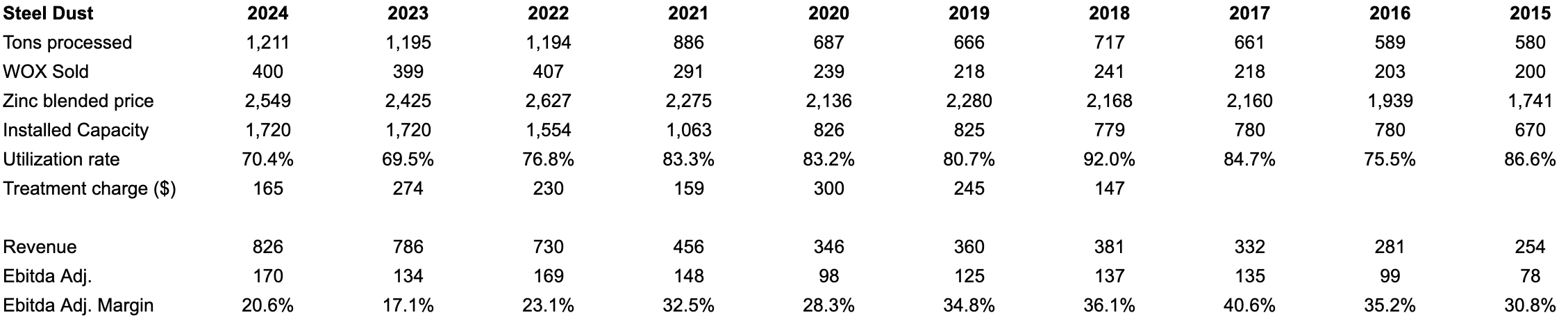
The TC is negotiated annually around March-April, typically quoted in dollars per ton of zinc concentrate (or oxide) processed. In 2024, it was set at 165$ in 2024. The charge is tied to the zinc content delivered and on the supply/demand dynamics of smelters. If Befesa supplies waelz oxide with 60% zinc, the smelter assesses the payable zinc (often 85–90% of the total zinc content, due to losses in refining) and applies the TC to that amount.
The final payment to Befesa is calculated as: (Payable Zinc Content × Zinc Price) – Treatment Charge
The zinc price is usually based on the London Metal Exchange (LME) spot price, but Befesa hedges a large part of its zinc production. Typically, it hedges 1-3 years forward, and targets 60-75% zinc content hedging, such that its historical average selling price fluctuates less than the spot market and Befesa is able to partly benefit from spikes in LME zinc prices.
Let’s wrap up :
1/ Steel dust is a hazardous material rich in zinc that Befesa is paid for for collecting ;
2/ Befesa processes the dust in-house into Waelz oxide before selling it to smelters ;
3/ Smelters process the oxide into zinc and charge suppliers a treatment charge ;
4/ Befesa hedges most of its future zinc sales ;
5/ Key metrics to follow are then : dust volume collected (ie utilization rate of plants), zinc blended price (mix of hedged prices and spot), and treatment charge level.
What about aluminium then ?
Similar story for the aluminium segment, except it has 2 parts.
The first relates to aluminium salt slags and spent pot linings (SPL). Those are byproducts of the secondary and primary aluminium industries. Both are considered hazardous materials too. Befesa is paid to collect and recycle them. The result is a mix of melting salt and aluminium concentrate. The former is sold while most of the latter is reused internally. It is the second part of the aluminium segment : Secondary aluminium.
Secondary aluminium is based on the collection and recycling of aluminium scrap and aluminium concentrate (source internally and externally). Befesa then makes aluminium within its plants and sells it to the automotive and construction industries.
The comments I made above regarding the barriers to entry, strict regulatory environment, and the no-it-will-not-be-vertically-integrated are valid here also. Basically, the model for the aluminium segment is the same as the one for the steel dust segment, so I won’t go in as much detail. However, it is way smaller in size as the following charts make clear.


Why is Befesa interesting now ?
Befesa’s profile changed drastically in 2021 when they acquired American Zinc Recycling (AZR). It gave them a footprint in a large EAFs market, the US. Overnight, their capacity grew 60%, from 1 million tons to 1.6 million+. A clear leader.
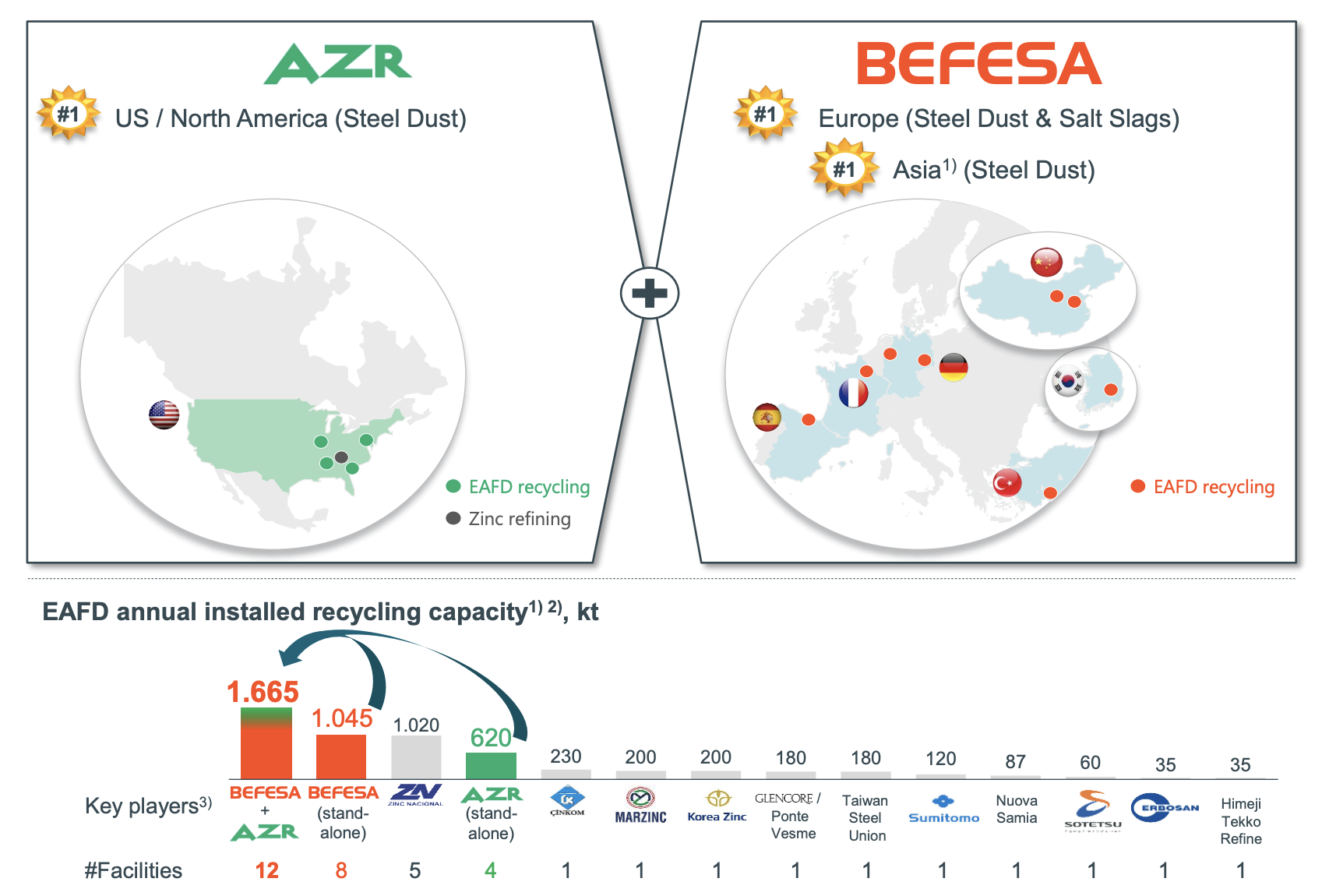
In an industry where greenfields projects are not common, M&A is a way to go, and when the #1 acquires the #3, it’s an event. Befesa paid 450m$ for 620kt of capacity, ie 0.7m$ per kt.
This operation changed the nature of Befesa and de-risked its operations by making it less reliant on one geography – Europe. It also came with a bonus prize : it’s true that greenfields projects are scarce, but brownfields in the form of capacity expansion are common. The operation with AZR gave them just that : the ability to reinvest directly in the business to satisfy future demand. It’s what they did for instance at Palmerton by adding 60kt of capacity. Similar opportunities are seized in Europe in the aluminium segment. In each case, capacity addition is precontracted such that Befesa doesn’t kill the market by oversupplying it. Both projects are well advanced and will soon be online, mechanically increasing the earning power of Befesa. This is the first kick.
The second one is the improved hedging level regarding zinc in 2025 and 2026. Without integrating any improvement in utilization rates, higher hedging prices will increase Befesa’s Ebitda by 10%+ in 2025.
All this is happening on the backdrop of an improving industry. The big picture for Befesa is quite simple : due to a focus on CO2 emission reduction, more and more EAFs are being built in the world (from <30% of steel production now to >35% in 5 years). As I said, they need to recycle their dust. But the recycling industry is largely concentrated and is acting rationally, slowly adding capacity. It ensures their utilization rates are going higher over time, mechanically improving their returns. This is happening now, especially in the US where Befesa utilization rates have been low but steadily increasing. The picture for the aluminium industry is similar, driven by the increased adoption of aluminium in construction and auto industry (lighter vehicles for better performance, be they ICEs, hybrids, or EVs).
Then of course there’s the wild card : China. Befesa is already there, through 2 plants. However, utilization rates are really low because of low production from EAFs (during a downturn, it’s easier to close EAFs than BOFs). But there’s a strong push from the Chinese government to use EAFs (capacity increase of 60mt over the next few years, ie 75% of US total production). The Chinese downturn will end at some point, EAF capacity will grow as a percentage of total production, and Befesa will first see its kilns start printing money there (they’re at breakeven now) and then will benefit as they already have plans in place to increase capacity.
Any risk on the debt front ?
Befesa has c700m€ of gross debt and 620m€ of net debt. It has one large instrument : a 650m€ term loan maturing in 07/2029 (recent refinancing). It bears a variable interest rate of Euribor + 275bps (means c5% today). At such a level, it means <35m€ of interest. Befesa’s Ebitda has never dropped below 115m€, even before it substantially increased its capacity with AZR.
Will it have trouble paying these interests going ahead ? I don’t think so, even with rates doubling and current Ebitda slashed by half, interests would be well covered. Current Net debt/Ebitda stands at 2.9x, expected to drop to 2.5x by 2025 year-end (target then is 2.0-2.5x), triggering a drop in rate of 25bps.
Any covenants that could pose a problem ? Term loan is covenant lite. The 100m€ RCF (fully undrawn) has one : Net debt/Ebitda must be <4.5x. Only applies if at least 40% of the RCF is drawn.
So is there any risk on the debt ? No.
What about management ?
Asier Zarraonandia is the Chief Executive Officer since 2022. He’s been with Befesa since 2001, previously leading the Steel Dust Recycling Services unit as Vice-President (from 2006). Well, I think he knows what he’s doing. Unfortunately, I don’t think he owns that many shares. He purchased 40k shares on the market since becoming CEO (more than double its initial stake) for a total of 1.2m€ (most recent operation : 10k shares at c20€ in December 2024.
The CFO is Rafael Perez. He was nominated in 2023 but has been working at Befesa since 2006. He was in charge of Investor Relations and Strategy before (not a transition I really like). No information about the stocks he owns, no reason it should be an interesting number.
Finally, Javier Molina is the Chairman of Befesa. He’s been a central figure since 2000, when he took the helm of Befesa Medio Ambiente, steering the company through its growth into a global leader in recycling hazardous residues. He held his CEO position until 2022. He owns 135k shares, last purchased in November 2024, 26k shares at c20€.
Are they rock stars that are going to revolutionize the world ? I don’t think so. But I’m glad because nobody’s asking them to do so. However, they know how to transform dust in euros, they are good at it and will continue to do so at a larger scale over time.
What will Befesa earn in 3-5 years ?
Let’s take each segment individually.
For the steel dust, assuming a capacity growing to 1.8m tons and a utilization rate of 80% (average L10Y), we get 1.44 tons of processed dust. Keeping a zinc price flat at 2,600€ and a TC increased to 200$/180€, we get to c600m€ of revenue for the recycling part. Assuming it represents 65% of the steel dust segment revenue (historical average), we get to 900m€+ when taking the collection fees. Modernization at plants and improved utilization rates will then drive operating leverage up. We saw Ebitda margin north of 30% or even 35% at similar utilization rates, so I’ll use 30% in my scenario. I get to 270m€ Ebitda then.
For the Salt slags segment, the installed capacity will be around 530kt in 3-5 years. Historically, Befesa has made 200k€ of revenue per kt of salt slags/SPL recycled. It has also run its plant at high utilization rates, >90%. I’ll keep these 2 assumptions as they seem conservative enough to me : Befesa has made 240k€ per kt over the L3Y, and capacity expansion has been pre contracted. Sales should then be around 100m€. Ebitda margin in that segment has hovered around 30% over time, I expect it to stay in that region. This gives me an Ebitda of 30m€.
Finally the Secondary aluminium segment. I expect it to be run as it has been historically, with no change in capacity at 205kt. I assume 85% utilization rate and 2m€ of revenue per kt. It gives c350m€ of revenue. With 4% of Ebitda margin, we get close to 15m€ of Ebitda.
Wrapping it up, we get to 315m€ of Ebitda in 3-5 years.
Since its IPO, Befesa has traded between 6-15x EV/Ebitda. If we exclude the Covid bonanza period of mid 2020 to early 2022, multiple was in the 6-11x range. Assuming future multiples of 6x (current one), 8x, and 10x, it gives the following results over 3 years and 5 years.
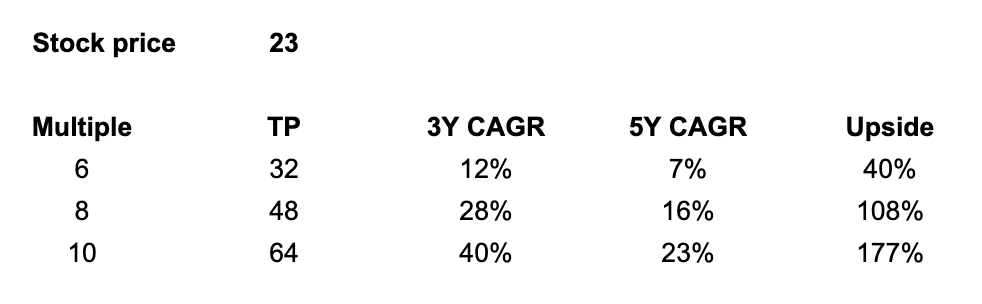
That seems pretty good to me, and it doesn’t even include the dividend that could add 2-4%/year.
What about the replacement value of assets ? Well, assuming 1,800kt of steel dust capacity and 0.7m$ per kt (price paid for AZR), steel dust assets value is close to 1.2bn€. Assuming a similar price per kt for aluminium slags (same margin and capex profiles), it gives them a value of 300m€. Befesa’s current EV is equivalent to the value of these assets. We should then add the value of 2nd aluminium assets and of specific assets like zinc refining and stainless steel dust. Befesa currently trades at a slight discount to the replacement value of its assets.
At this level, I own a position.

0 Comments