
3 weeks after the BRK AGM and 3,500 miles across Nebraska, South Dakota, Montana, Wyoming and Colorado, I’m back home.
I had plenty of time to digest the weekend in Omaha. I’ll try to keep it simple and mostly personal as many things have already been written/said about it – I particularly recommend listening to this podcast of William Green.
1/ The atmosphere
It was my 4th time attending the BRK AGM this year. It was fully packed, even seats behind the scenes were full. Buffett shared a few numbers at the beginning of the AGM : nearly 20,000 people at the fair (highest ever), more than 300,000$ of sales for both See’s Candies and Brooks, 3 000 people running the Sunday 5K… Record figures everywhere according to Buffett. You can check the replay here.
As always it was refreshing to reconnect with familiar faces and meet new ones, especially at a time when volatility made a comeback. What was interesting to see and hear was that nobody was fearful regarding the current situation (way more volatile at the time than today, but perhaps not more risky). I haven’t spoken to anybody who doesn’t find interesting situations at the moment and who’s not fully invested. However, as always, what’s risky for person A is often where person B sees opportunity – and vice versa – so opinions were diverse and views refreshing. One thing where everybody converged however : people don’t want to invest in cyclical businesses anymore, everybody’s talking about quality. I think it leaves plenty of fish in ponds where nobody wants to fish anymore. Well, that’s good news folks !
2/ Events around the AGM
For those who’ve already made the trip to Omaha, you know that the Berkshire weekend is way more than the AGM. Let me quickly explain for those that never made it to the Cornhusker State. Berkshire AGM is on the first Saturday of May. However, plenty of events are held from Wednesday to Sunday. Most are free and non-exclusive. I attended the Q&A session of IMA/Vitaliy Katsenelson, the ValueX BRK of Guy Spier, the value investing panel at Creighton University, the Robotti lunch, the Markel brunch, and multiple events organised by Tilman Versch and his Good Investing community.
Here are the videos of Bryan Lawrence and Luca Dellana, two of the presentations I found the most interesting. Bryan talked about the US deficit and a low hanging fruit to reduce it. Spoiler : it’s healthcare costs, far higher than the rest of the world. This is a major topic/issue and Bryan’s presentation clearly lays out the ins and outs.
Luca’s presentation was closely related to my “Should I stay or should I go ?” article. I think Luca’s methods are really interesting for investors and help a lot in minimizing errors. I highly encourage you to watch both videos (and the whole event) and tell me what’s your opinion on them !
3/ What to expect next year ?
The initial uncertainty regarding Buffett’s presence on stage next year has been lifted : he won’t be there to answer questions. What will be the exact format of the AGM ? We don’t know yet. Just Abel for a couple of hours ? Jain also ? We’ll see. One thing we can be sure of is that it will be highly interesting : though Abel has been working for Berkshire for a quarter century, and has been in the spotlight for years now, we still have much to know about him. Him being the central figure now will make it easier for us to evaluate him. Buffett’s confidence in him is total, ’m looking forward to learning more about him.
As for the Berkshire weekend around the AGM, I don’t expect much change for next year. I expect the AGM to stay in Omaha for the foreseeable future – even though Abel is based in Des Moines. Will it change once Buffett is gone ? Maybe, but I’m doubtful. Decades of AGM in the same “remote” place says something about a company, about its culture. When you have tens of thousands of people making this specific trip every year, it fosters a unique atmosphere. The multiple events I mentioned above, and all the others I didn’t attend – and others I may not even be aware of – are all occasions of gathering like-minded people as nowhere else. Returning to Omaha each year creates a continuity in the relationships you forge, it’s like 1 year of meeting and networking condensed in 1 week. I don’t see that changing anytime soon.
Pages and pages have been written about Berkshire beyond Buffett. His footprint is all over the place at the company, in the culture and the way it is managed. Buffett leaves a significant legacy to Abel (and even that feels like an understatement) as well as enough cash (300bn$+ as of Q1 25) to paint his own corner of the canvas. I’m excited to enter the Abel era at a time when the market regime is changing also. As Bob Robotti concluded : cheer up, the coming decade will belong to stock pickers ! Let’s see how Abel drives us through it !
Following Q1 earnings season, it’s time to wrap up the updates on the companies I previously wrote about.. So here we go :
Galapagos :
Things changed… and then changed again. After announcing a separation of activities in early January (cf my article Galapagos : drowning in an ocean of cash) and the nomination of a new CEO in late April (Henry Gosebruch), Galapagos announced on May 13th it was re-evaluating “the implementation of the previously announced separation following regulatory and market developments”.
What does it mean ? No more spinoff, everything remains under the same roof. Add to that two things : 1/ Paul Stoffels leaves immediately, and 2/ Jérôme Contamine (ex CFO of Sanofi) becomes Chairman of the Board.
Gosebruch made it clear in the press release that he was now the captain and that 1/ he was looking to get rid of sell the current pipeline, and 2/ he’s looking for acquisitions. Clearly Gosebruch clearly isn’t interested in handing out a 500m€ “gift” to a spinoff – which he probably thinks is doomed – and prefers to keep this dry powder for himself. In my opinion this is a good thing for shareholders. The stock still trades at a substantial discount to cash. At 26€ per share, we’re still 40%+ below cash level. Interesting, to say the least.
Olin :
The chlor-alkali leading company continues to suffer in each of its segments. Demand for chlorine, caustic soda and their derivatives remains subdued, while competition from China remains fierce on certain materials (epoxy mainly). The result is both pressured volumes and prices, even though it must be noted that the CAPV segment – the largest one – has kind of stabilized for a few quarters now around 900m$ of sales and 180m$ of Ebitda.
It’s also tough for Winchester. Commercial customers are still going through their destocking process, greatly impacting results – 32m$ Ebitda vs 80m$ a year ago. Overall Q1 Group Ebitda reached c190m$. Operating income has halved, reaching c45m$, just enough to pay interests and seeing net income breaking even. (I saw receivables continued to increase during this quarter, reaching 1.1bn$ vs 900m$ a year ago – with LTM sales identical to 6.6bn$. No red flag yet, but I’ll keep a close eye on it.)
Next quarter is expected to be the same as Q1 from an Ebitda standpoint, between 170-210m$. No inflection coming soon, though management expects improvement in both Epoxy and Winchester in the coming 12-18 months. Management focuses on cost control now, ensuring cash generation, though minimal, is still there. No change in strategy : production is set based on the lowest side of the ECU.
There’s no debt reimbursement before 2029 and the 1.2bn$ RCF was extended to 2030 : Olin has what it takes to weather the storm. At 20$ a share (5.2bn$ total EV), I find the valuation very compelling knowing we can wait for the business to reach the upcycle phase (with peak Ebitda >2bn$). Let’s see how next quarters unroll.
Befesa :
These Q1 results from Befesa are honestly really good. Even with steel dust volume decreasing 9% and utilisation rate of 64% (vs 70% for both Q1 24 and FY 24), sales improved by 3% YoY to 308m€, and Ebitda by 15% to 56m€ – with Steel segment Ebitda +37% and Alu segments Ebitda -32%.
Two reasons for that : 1/ increased zinc prices (as explained in my article here), 2,620€ vs 2,400€, thanks to improved hedge and spot levels, and 2/ the treatment charge cut in half at 80$ (vs 165$ in 2024). The drastic change in TC reflects a reversal in supply/demand dynamics in the zinc industry : smelting capacity has increased while zinc concentrate volume in the market has been reduced. Mechanically, you get a lower TC.
Management provided guidance for 2025 Ebitda, between 240-265m€ vs 213m€ in 2024 (ie +13-24%). This increase is explained by a positive impact from zinc hedging prices of +20m€ and a lower treatment charge, 18m€ positive impact.
Steel dust volume was down during Q1 because of planned maintenance. It will pick up during the rest of 2025. It will also benefit from the 2nd kiln in Palmerton (completion during Q2). And, of course, China is still really low, with a c50% utilization rate : it will increase as the economy improves and EAF production picks up (late 2025 according to management).
As for the aluminium segments, the situation is a bit more contrasted. The aluminium demand in Europe is weakening, especially the auto one, pressuring prices. When combined with higher energy prices you get an Ebitda dropping by 30%+.
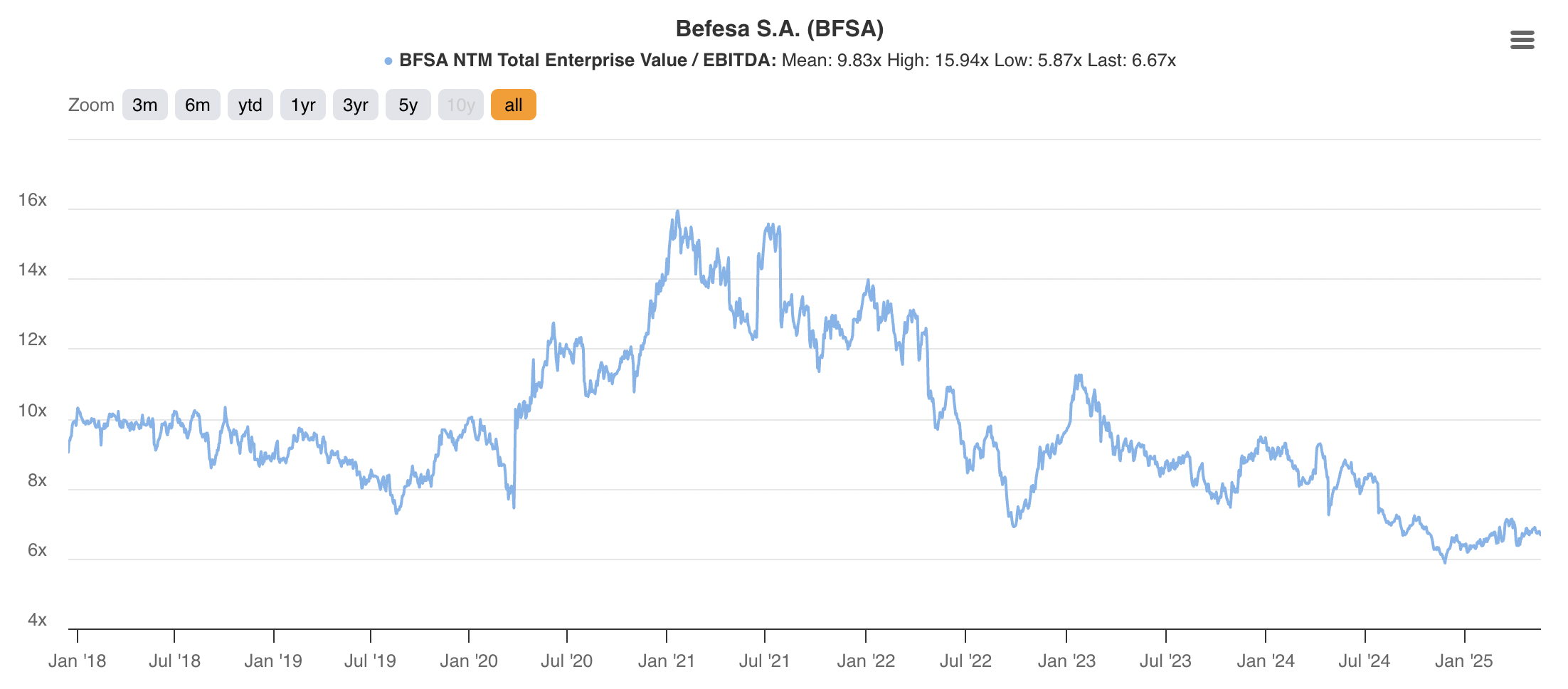
Where does that leave us in terms of valuation ? At 26€ per share, the market cap is slightly above 1bn€. Net debt reaches 610m€, so EV is 1.65bn€. In terms of EV/Ebitda ratio, we’re at 6.6x, still really low vs history (cf chart below, source : TIKR.com). Same situation in terms of PE : Befesa should land between 2.2-2.5€ EPS in 2025, so PE is 10-12x, historically low.
Given the low valuation starting point and the growth profile for coming years, we should benefit from 2 engines in the future : increased results and higher multiple. I maintain my position and my objective of c50€ in 3-5 years (+13-23% CAGR).
Read more in my article : Befesa : steel dust, dirt cheap.
Capri :
The aspiring luxury holding company (sigh) hasn’t published yet so I don’t have specific comments yet. Results will be online next week. However, other luxury houses’ results show that the sector is suffering. At LVMH, the Fashion and Leather division shows an organic growth of -5%. Gucci shows an incredible -25%, YSL -9%, Burberry -6%. Of course you can always mention Hermès +7%, Richemont +7% or Brunello Cucinelli +10%, but honestly, who would compare Capri to them ?
Revenue consensus for Capri is around -20%, so don’t expect any sparkle. Of course, you know that the attention will be on the asset sales. We’ll get an update on Versace, which shouldn’t pose any problem with a closing in H2 25, and I hope, news regarding Jimmy Choo. There’s no doubt it will be sold as the wording in Versace’s press release makes clear : “Enable Capri Holdings to make accelerated strategic investments in Michael Kors.” Let’s see what John Idol has to say next week.

0 Comments