Summary:
-
Olin is the number 1 producer of chlorine and caustic soda in the US.
- It benefits from a favorable industry structure characterized by a growing demand and a relatively fixed supply, all while benefiting from the lowest cost structure in the world.
-
It also owns Winchester, the largest small ammunition brand in the world, which benefits from its own tailwinds.
-
Olin’s valuation has recently taken an excessive beat and offers a substantial risk/reward position for those ready to ride the upcycle.
-
Upside potential with IRR of 25-40% for the next 5 years, x3-5 from today’s price.
What’s all this about ?
Olin’s main business is based on a simple chemical reaction whose coproducts serve as precursors in many everyday products : chlorine and caustic soda.
What’s that reaction ? Well, it’s the famously known chlor-alkali process. That’s not new in case you wondered, the process has been refined since the discovery of chlorine by Scheele in the late 18th century. And Ok, it’s not that famous either.
Let me try to explain it briefly. You take salted water (in the form of brine: H2O + NaCl, that is sodium chloride) and you pass electricity through it (electrolysis) such that you “reorganize” the molecules.
So basically at the beginning you have NaCl + H2O. Then you have Cl + NaOH + H : Chlorine, Caustic Soda and Hydrogen.
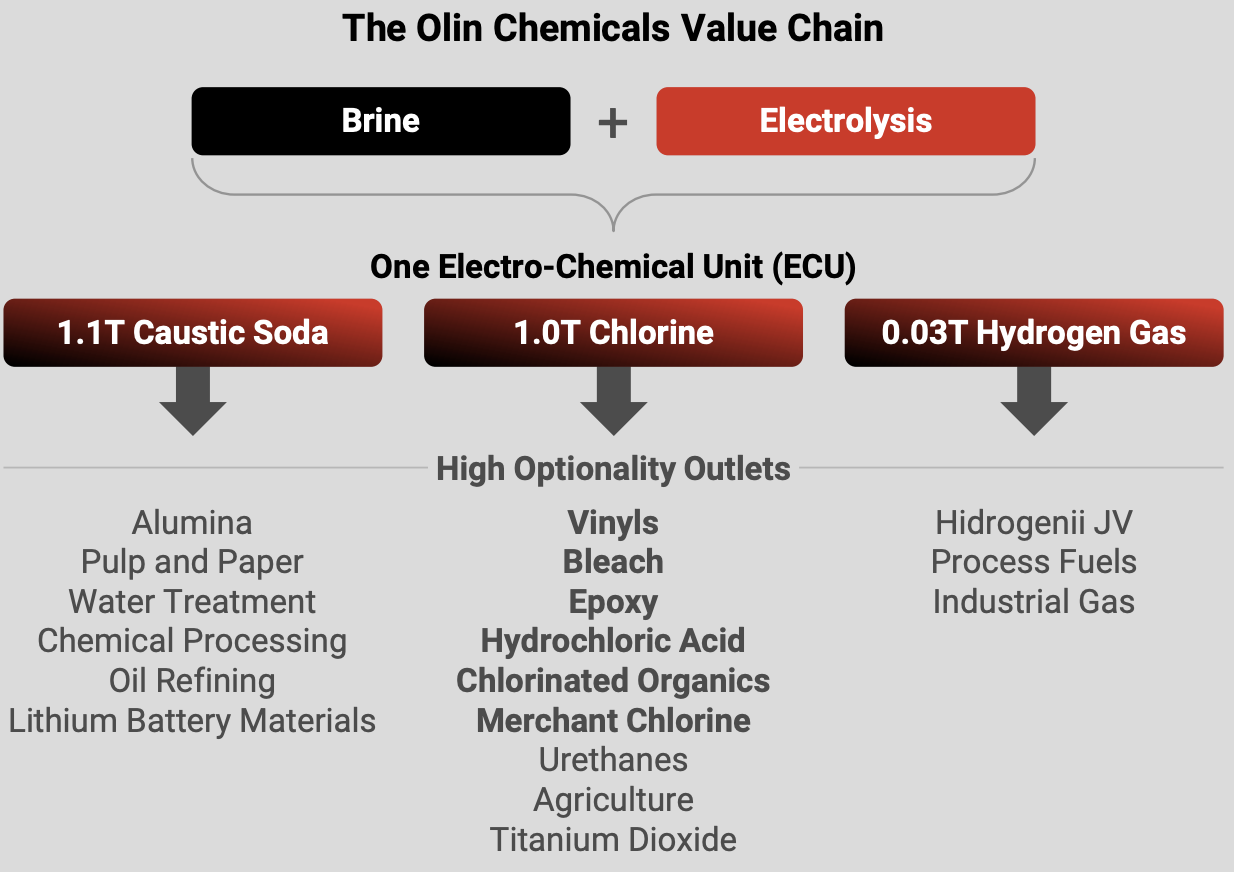
The result of that reaction is called an Electro-Chemical Unit (ECU) and gives fixed proportions of each product.
Easier to visualize it with an image :
What are they used for ?
Both can be sold as they are or further transformed into other value-added products like bleach, epoxy, PVC… We find chlorine and caustic soda in various forms in most of the things we use everyday.
The shampoo you just bought ? Caustic soda in it.
The bottle it’s in? Made with chlorine.
The credit card you used to pay? Chlorine again.
In fact, the main end use of Chlorine is PVC (>30% of demand), and guess what, we use PVC everywhere, especially in the construction industry (pipes, flooring…). The US housing deficit is still huge (cf Harvard review), giving a tailwind to chlorine demand. Water treatment is also an important end market.
For Caustic soda, the main end market is the production of aluminium. Other important markets are detergents or pulp & paper (think about your Amazon box).
Quick rule of thumb: chlorine demand is tied to the housing market (new and maintenance/remodeling), and caustic soda to industrial production (ie more like GDP growth).
So here’s the issue : caustic demand is quite sticky while chlorine demand is more cyclical. And as both are coproducts of the same chemical reaction, it can easily create a supply/demand imbalance. There’s something to do there maybe? Exactly and we’ll see that. But first let’s look at Olin’s position in the industry.
Olin position in its industry:
25 years ago, the industry was made of 30+ companies in the US. Through multiple operations, we today have 4 companies that dominate it : Olin, Westlake, OxyChem (Occidental Petroleum), and Shintech. They own 70%+ of the capacity. Olin is the largest, having 30% of production capacity.
This situation is quite recent. Back in 2015 Dow decided to dispose of part of its chlor-alkali capacity before merging with Dupont : it enabled them to focus on higher margin businesses and to avoid regulatory scrutiny.
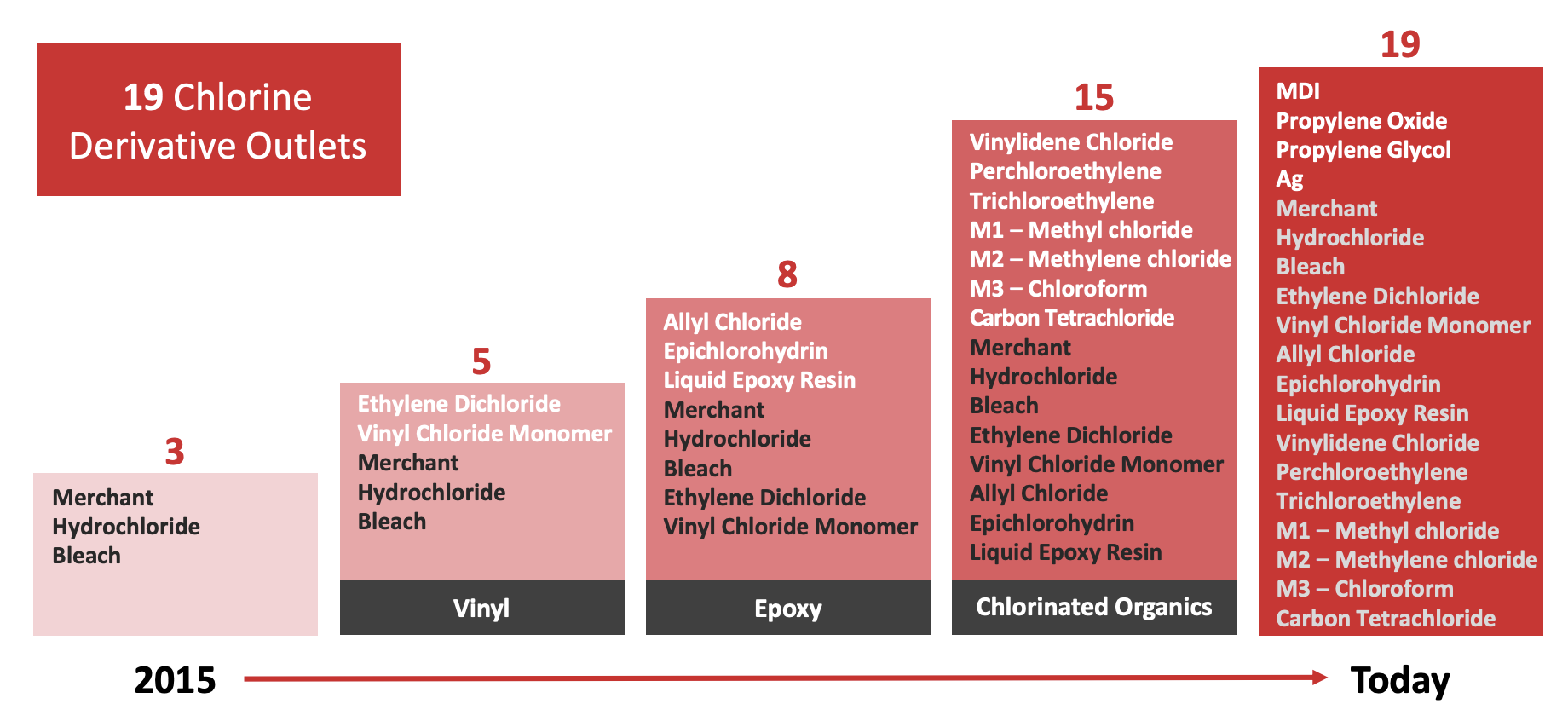
Overnight Olin became the 800-pound gorilla. It operated 6 million tons of capacity, 7% of worldwide capacity. One of its plants, Freeport, made approximately half of it. It’s the largest in the world to this day. Olin chlorine portfolio went from 3 products to 19 (o/w Epoxy, stand alone segment, 20% of sales), making it possible for them to choose which way to go downstream so they create more value.
From that point, it means they basically have to make 2 choices everyday:
1/ set the ECU production level ;
2/ select which path they will send the chlorine through.
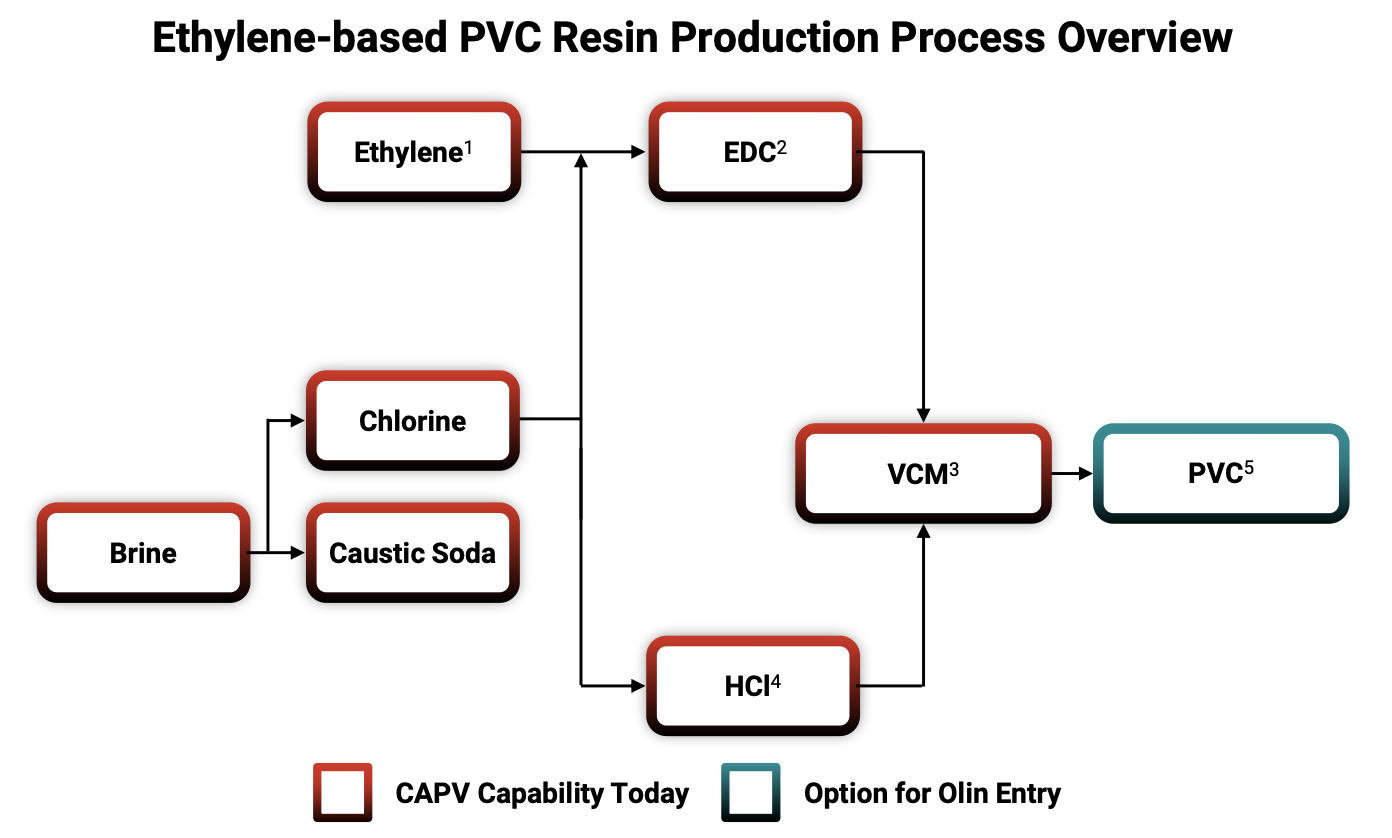
Since then, Olin has shunned its non-economic capacity, focusing only on assets earning in excess of its cost of capital. Today it operates 4 millions of capacity, 30% of US capacity. This is crucial because its size gives it an advantage which is compounded by its geography.
From the first part, you remember that you must have 2 things to produce an ECU : brine and electricity. Brine has been owned for decades close to each plant and represents <20% of ECU production cost. Not a problem.
However, electricity is 80% of variable costs so its price can substantially impact profitability. But Olin enjoys a strong structural advantage : being in the US gives it access to cheap gas which in turn transforms into cheap electricity. It’s a structural advantage that Asian players don’t have (let’s not even talk about European ones).
This is compounded by the fact that ethylene in Europe/Asia is derived from naphtha (ie oil), while in the US it’s derived from ethane (ie natural gas). And natural gas in the US is way cheaper than oil elsewhere : on an energy equivalent basis, natural gas at 4$ is the same as an oil barrel at 24$.
Last thing : during the 2015 transaction, Olin and Dow signed an agreement (for which Olin paid 1bn$+) for Dow to supply ethylene at cost. It runs through 2040.
The result is kind of a Lollapalooza effect where Olin is the lowest cost producer within a rational oligopoly where supply is fixed and demand rises over time.
These advantages were not enough for Scott Sutton, the CEO named in 2020. Remember we said above that chlorine and caustic soda demands had their own kind of independent paths. Well this is a problem.
Why? Glad you asked!
The issue when producing coproducts is that you can only adapt to one side of the equation, not both. You see that product A is heavily demanded, you produce enough to satisfy that demand. At the same time, you overproduce product B, you destroy its price and the potential benefit you had from a stronger demand for product A.
Chlorine has the upper hand in the chlor-alkali business. For a simple reason: most chlor-alkali production capacity is owned by PVC producers. When they see demand for PVC increasing, they increase their ECU production. No problem for the chlorine side because it has a place to go with the PVC demand. However for caustic soda, there’s no demand spike. So if there’s an increase in supply, no more demand, only one thing can adjust : price. PVC producers don’t really care as they make more money from PVC, but for Olin – which doesn’t produce PVC – the picture is contrasted : the extra profit it makes on the chlorine side is eroded by the hit it takes on the caustic soda side.
Sutton saw that and decided to reverse the process : from now on, Olin is adjusting to the lowest demand side. It only produces the quantity of chlorine or caustic soda that makes sense economically for them. They’ll not serve markets where producing more means losing money. They use the capacity of other producers to serve their extra demand meaning they protect their margin by not being forced to dump tons and tons of products at whatever price. It means they are ready to accept a very low utilization rate when demand is not there: currently it stands at c50% while competitors are at 70%+.
This changed the way they make business and though it doesn’t delete the cycle, it makes it less important. Olin’s second business also tends to make it less cyclical.
A shot at Olin’s second business : Winchester
Winchester has been part of Olin’s history for almost a century now. Today, they only manage the ammunition part of the business. Small caliber ammunition for commercial and defense customers, that’s it.
Winchester is the n°1 brand for hunters/shooters and is the n°1 supplier of small caliber ammunition to the US military. Regarding that latter part, Winchester is managing the Government owned facility in Lake City, the world’s largest, until 2030. It’s been awarded the highest possible grade regarding that contract recently, which bodes well for the second contract they bid on which will start in 2027.
Winchester enjoys multiple tailwinds, both on the commercial side and on the defense one.
Commercial : 1/ it’s the leading brand in terms of sales and recognition in the US, 2/ it benefits from the increase in US target shooters to 60m+ (+5% CAGR over the last 10 years), and 3/ increase in gun ownership (+5% CAGR since1998 in the US).
Defense: 1/ Governments increasing military spending, and 2/ increase in contracting by US Government (GOCO: Government Owned Contractor Operated).
How does that translate financially ?
Olin operates 3 distinct segments : CAPV (Chlor Alkali Products & Vinyls), Epoxy and Winchester.
(NB: CAPV and Epoxy are strongly related as Epoxy’s primary feedstock is chlorine. The Epoxy segment consumes c10% of Olin’s chlorine.)
Here are the results since the Dow operation:
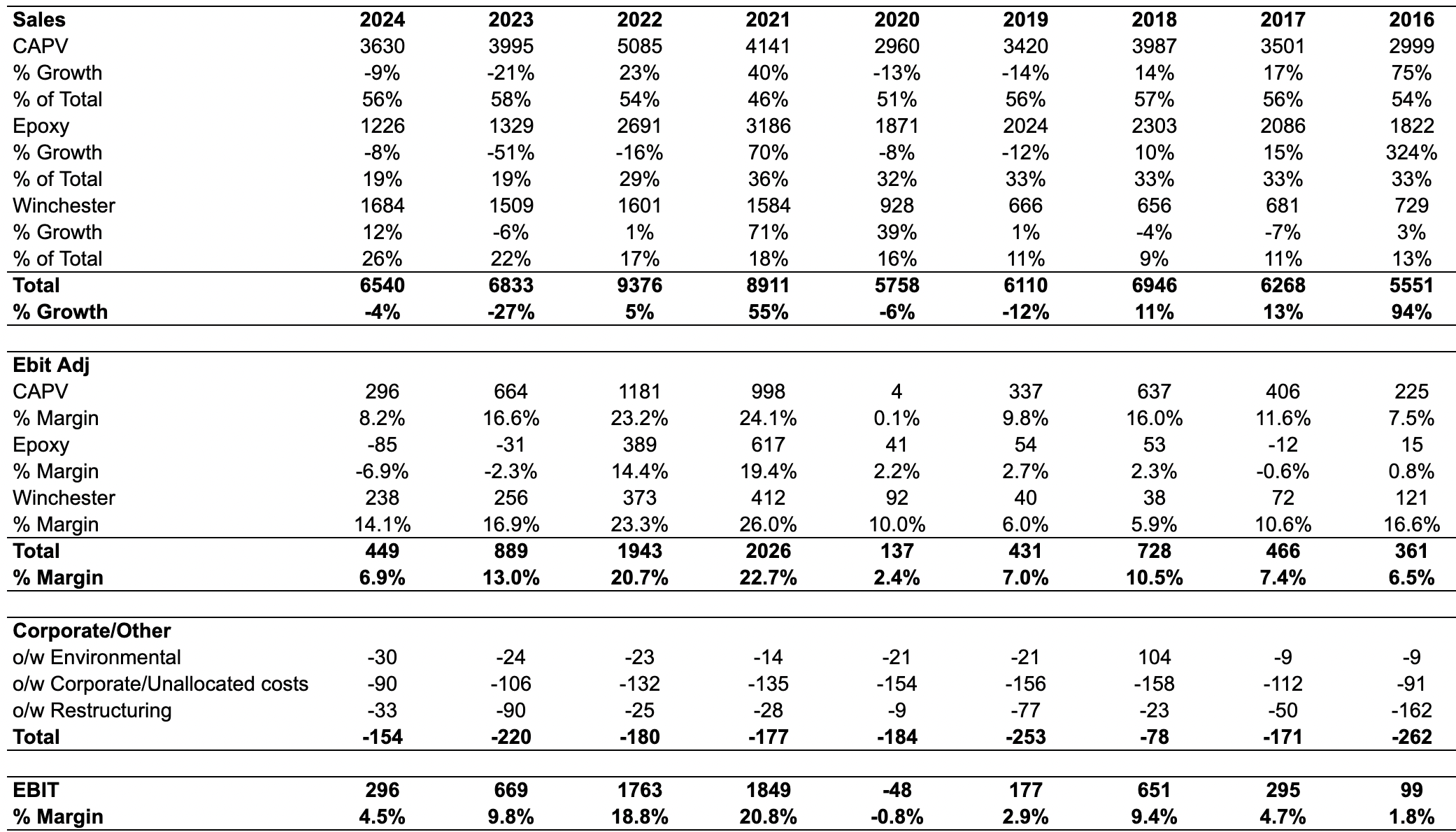
A few quick remarks :
-
CAPV is the largest part of the business, both in terms of sales and operating results. Its Ebit is way lower than a few years back, but it’s still making money even though utilization rates are probably at an all time low. Without the change made by Sutton, it would probably be closer to 0.
-
During the 2015 operation, Dow contracted its supply of chlorine until 2025 at a producer cost price. It represents c30% of Olin’s production so the repricing will be positive from 2026.
-
Epoxy is suffering A LOT. This is due to one thing : though chlorine is not easy to transport (by railcar it’s ok, but by ship, forget it), for Epoxy it is. So Asian producers, mired in their own trouble at home, are dumping their products in North America and Europe (where Olin operates a large Epoxy business at Stade, Germany). Everybody suffers and the situation shouldn’t change before antidumping measures are taken (should be the case in H1 2025) and/or the situation improves in Asia/China.
-
Winchester profile has dramatically improved since it signed agreements with the US Government and both defense/commercial volumes increased post Covid. It’s been suffering a bit from destocking for a few quarters but the situation is improving.
-
And, well yes, Olin is still a cyclical business.
Despite all the changes and fluctuations, it’s remarkable that Olin has been able to print money every year. Average yearly FCF since 2016 is c600m$ – this is post 180m$ of interests on the debt.

Management & Capital allocation
So Scott Sutton was nominated CEO in 2020 and put in place the “short-end” strategy we mentioned above. However, it was announced in September 2023 that he would leave his position in H1 2024 (he did in March 2024)*.
Kenneth Lane replaced Sutton in early March. He comes from LyonDellBasell where he was in charge of olefins and polyolefins. Before he worked for BASF on the polyurethanes and monomers side. You find chlorine, caustic soda or one of their derivatives in each of the materials. So Lane knows what he’s talking about.
He’ll continue the same strategy so nothing new on that front. However, he’ll do something Sutton hadn’t tried : enter the PVC market. During their CMD last December, he announced that Olin will put a toe in the PVC pool through a partnership with Kem One.
Integrating into PVC downstream gives Olin another outlet for their chlorine. Contrary to what happened during previous cycles, they’ll be able to benefit more from the upside : they’ll still be constrained by the weaker side ie caustic soda, except that this time they’ll benefit more from the upside of the PVC business. So ceteris paribus, they should earn more.
This is exactly what Westlake did decades ago so the playbook is clear and has room to grow. The good part of it is that it doesn’t cost a dime to Olin : it’ll be done through a partnership with Kem One as a first step (reminder : a world class PVC plant costs c5bn$ and takes 4-5 years to come online). More to come during next quarters but it would be a good place to allocate capital as they are the n°1 producer of the first building block of PVC.
Speaking of capital allocation, what have they done with their FCF since 2016 ?
We’ve seen that they acquired Dow’s assets in 2015. It cost them 5bn$+ in debt and stock. Post operation they had 3.5bn$ of net debt.
Before Covid, Olin generated 600m$ of cash per year (cash from operations). Capex was c300m$, not that high because it’s mostly maintenance (remember, they don’t grow capacity, they shrink it).
So they were left with 300m$ of cash to reimburse debt and return capital to shareholders in the form of dividend (Olin has been distributing a dividend for close to 100 years now). They continue to do so today. Dividend consumes 100m$/year (flat at 0.80$ for years now, ie yield <3% now). Net debt has been reduced to 2.7bn$ as of 2024 year-end.
When it rained gold in 2021 and 2022, they used their 3bn$+ FCF to repurchase shares also. Result : outstanding shares now stand at 115m vs 160m in 2021 (-30%). It still is an important part of their capital allocation as every other potential investment is judged based on that metric. At 25$, it has become even harder for other potential investments to pass the bar.
What could it be worth ? Is there any margin of safety ?
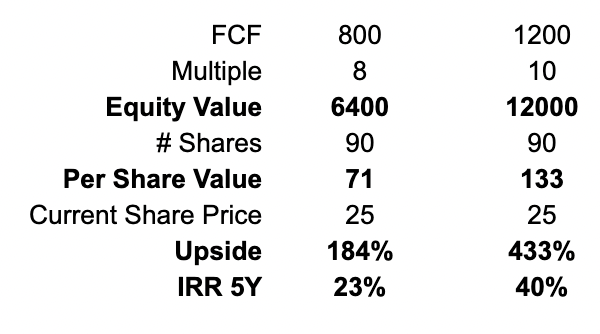
Olin’s 3 segments are currently at trough cycle, especially the CAPV/Epoxy parts with utilization rates at c50%. Olin’s management expects a mid-cycle Ebitda of 2bn$, that translates into 1.3bn$ of FCF. I’ll take a 800-1,200m$ FCF for my calculations : it’s in line with the last cycle Olin experienced and doesn’t take into account any progress the management can make.
Here are my other assumptions :
-
Due to the nature of the supply/demand dynamic in the chlor-alkali business, I expect the next mid-cycle free cash flow of Olin to be reached within the next 5 years.
-
Valuing it using a 8-10x multiple (10-12.5% yield), we get an equity value of 6.4 to 12bn$.
-
Assuming they repurchase for 1bn$ of shares for an average price of 40$ (50%+ above today’s price), the number of shares is reduced to 90m.
-
Implied per stock value of 70-130$. Over 5 years, that’s an IRR of 25-40%.
For the margin of safety, let’s check the replacement cost of its assets.
PCC just announced the construction of a 340mt chlorine plant for 540m$, ie 1.6m$ per mt. Olin has 4,000mt+ of capacity, Replacement cost is >6bn$, certainly way higher as Olin has the capacity to further transform its chlorine into other derivatives with a higher value. Assuming 2.7bn$ of net debt, equity value is 3.3bn$ ie c30$ per share. It excludes the value of the Winchester division, probably 10-15$ per share.
Risk/reward is clearly favorable on Olin with a substantial upside over the next few years. It’s one of my main positions.

0 Comments