

Company: MARR Spa
Country: Italy
Market Cap: €750m
Stock price: €11.5
Upside potential: 100%
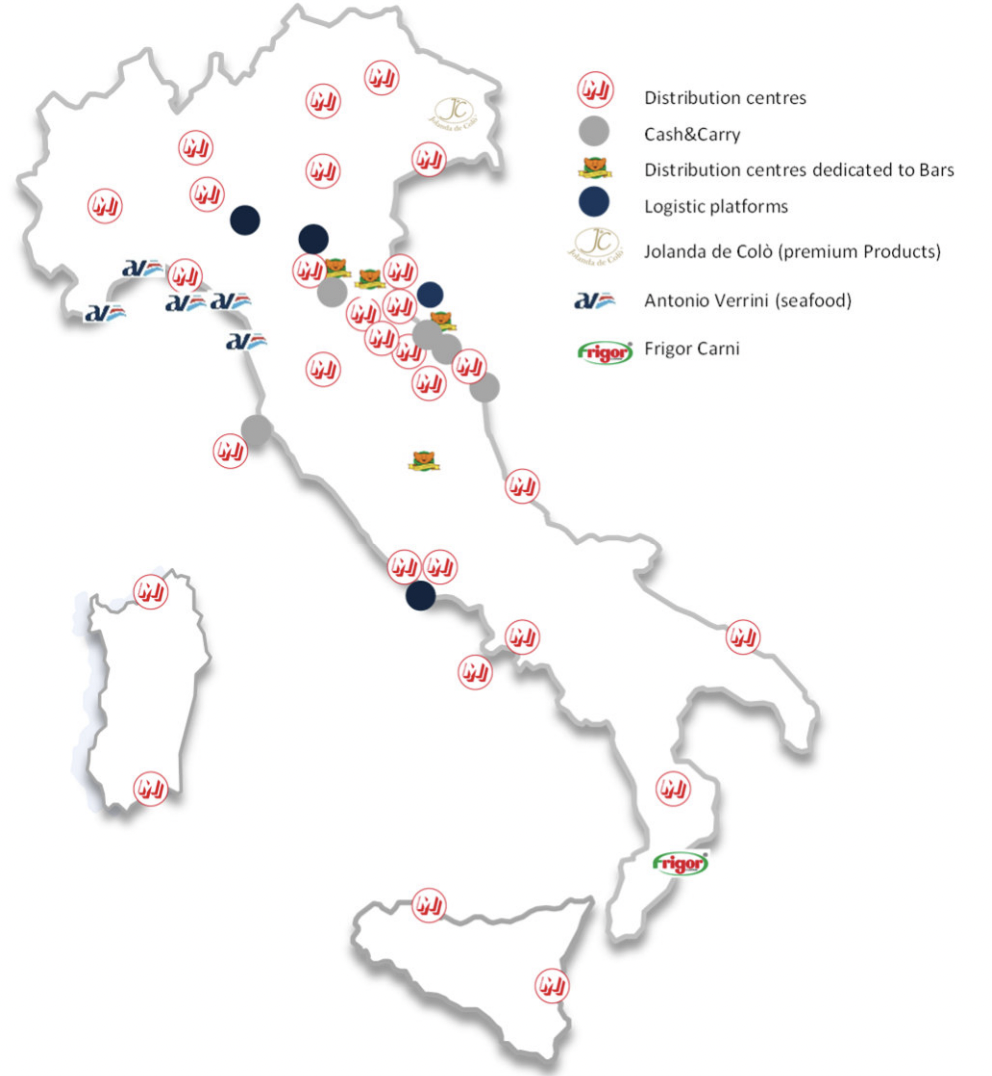
MARR is the leading foodservice supplier in Italy with a 17% market share among wholesalers (top 3 followers have 12% combined). It was founded in 1972 in Rimini and is present all over Italy through 40+ distribution centers. It serves 55k customers with 25k products (o/w 1,000 private label products) mainly via its c1,000 sales agents and its owned fleet of c1,000 trucks (also owns several cash and carry).
⅔ of customers are individual restaurants for which the range of offered products is critical: easier for them to have a unique interlocutor for their orders. So the wider the offer, the better it is to gain and retain customers. Other customers are chains, groups, canteens and wholesalers. Top 20 customers represent 15% of sales.
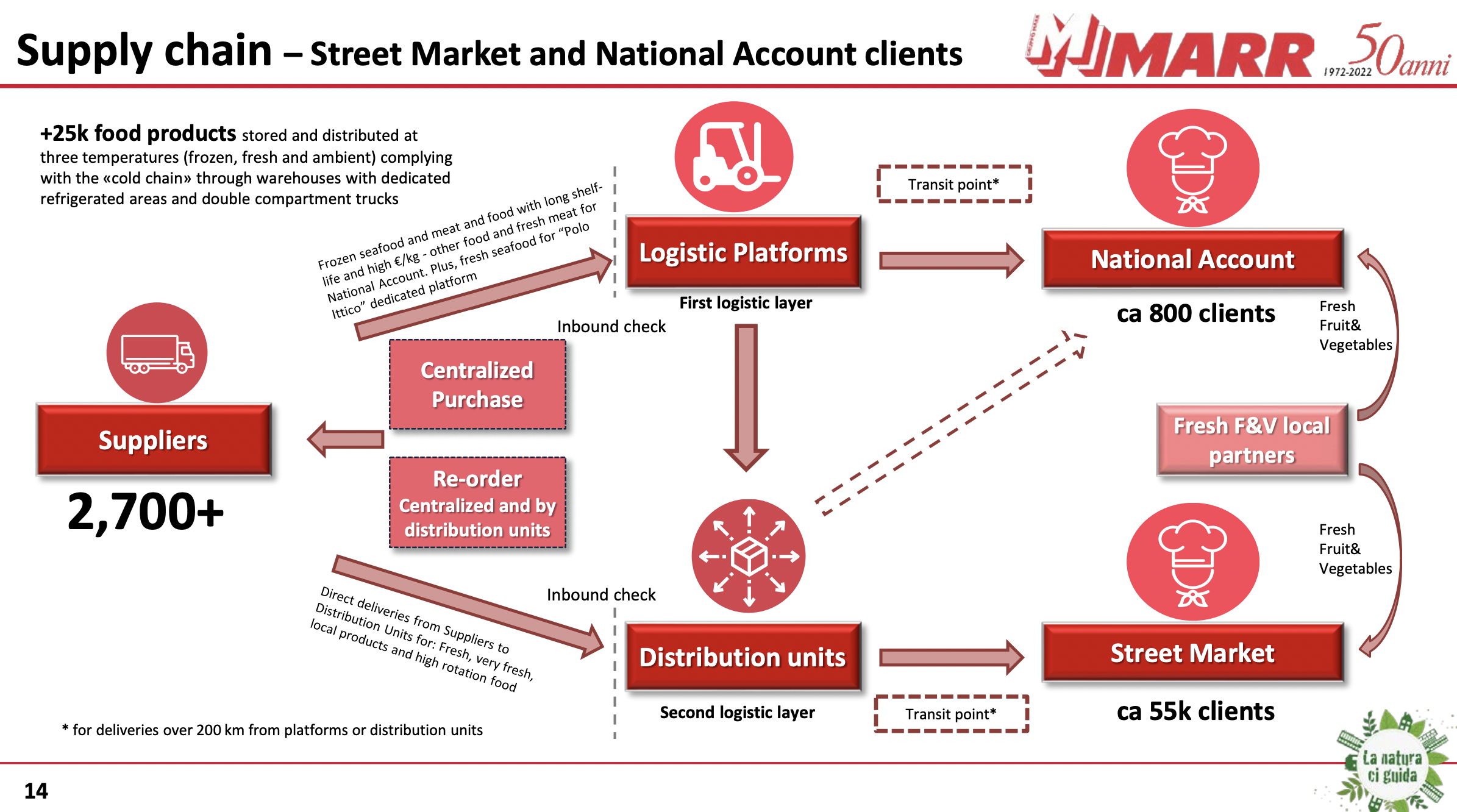
To get this wide offer, MARR works with 2,700 suppliers, mostly from Italy (top 20 suppliers represent 30% of COGS). Half of revenue comes from grocery, ⅓ from seafood, 15% from meat and the rest from fruits/vegetables (voluntarily low because the supply chain is different and potentially harder to master as they perish quicker).
All in all, I think this situation is self reinforcing for MARR.
From a customer standpoint, using MARR as a supplier is quite efficient because it gives access to the largest offer of products you need, a sort of one-stop-shop. You’re delivered within 24 hours in just 1 stop for all your products (their trucks have differentiated compartments to deliver at the same time frozen products, fresh products and room temperature products).
From a supplier standpoint, trading with MARR gives them access to its large pool of final customers, something that can easily attract new suppliers. MARR is a very large customer so it’s able to get better terms with suppliers.
From MARR point of view, you benefit from your dense network. The less your trucks have to travel, the more time efficient they are. It means that if you add one customer, your marginal fixed cost is close to 0. This is a clear cost advantage for the leader of that industry.
Another one is the ability to develop its own private label offering. Today it’s just 1,000 products but it covers ¼ of what they sell. This stat shows that many SKUs must have long inventory turnover and this is another positive aspect of MARR’s size: once you have the critical size to serve necessary products, you can add products that are quite specific. They may help you recruit new customers because they’re able to find them only at your place. It would not make sense for a small competitor to store such products.
Since 1979, MARR is controlled by the Cremonini Group which owns >50% of MARR’s outstanding shares. Cremonini is a vertically integrated group as it operates 3 main businesses: 1/ Production of meat (mainly beef and cured meat), 2/ Distribution through MARR, and 3/ Catering, mainly operating concessions in train, airports and motorways.
Financially, MARR has grown steadily at 5% since its IPO in 2005 with operating margin growing from 5% to c7% in 2019. Return on capital was also steady at 16% until 2019. Obviously, Covid disrupted the whole picture. Though revenue has fully recovered in 2023 – reaching €2bn for the first time ie CAGR +5% vs 2019 – its margin hasn’t recovered yet at 4%+.
Part of it is due to the willingness of management to sacrifice short term margin to gain market share. The other part comes from the increase in logistic costs. Both parts should be resolved progressively in coming quarters as MARR’s prices continue to adjust and the management focus is totally on the fixed costs part (cf investment plan below).
Current situation hides several things that have improved during the Covid period:
1/ Increase in market share that reaches 17%+ today. Geographic expansion is still a growth driver as Northern Italy still represents half of revenue.
2/ Controlled financial debt: as of 12/2023, net financial debt was slightly below the level reached in 12/2019 (€142m vs €150m) while Revenue went from €1.65bn to €2.03bn (+23%). However, I keep in mind that 60% of gross debt (€100m out of €265m) has a floating rate.
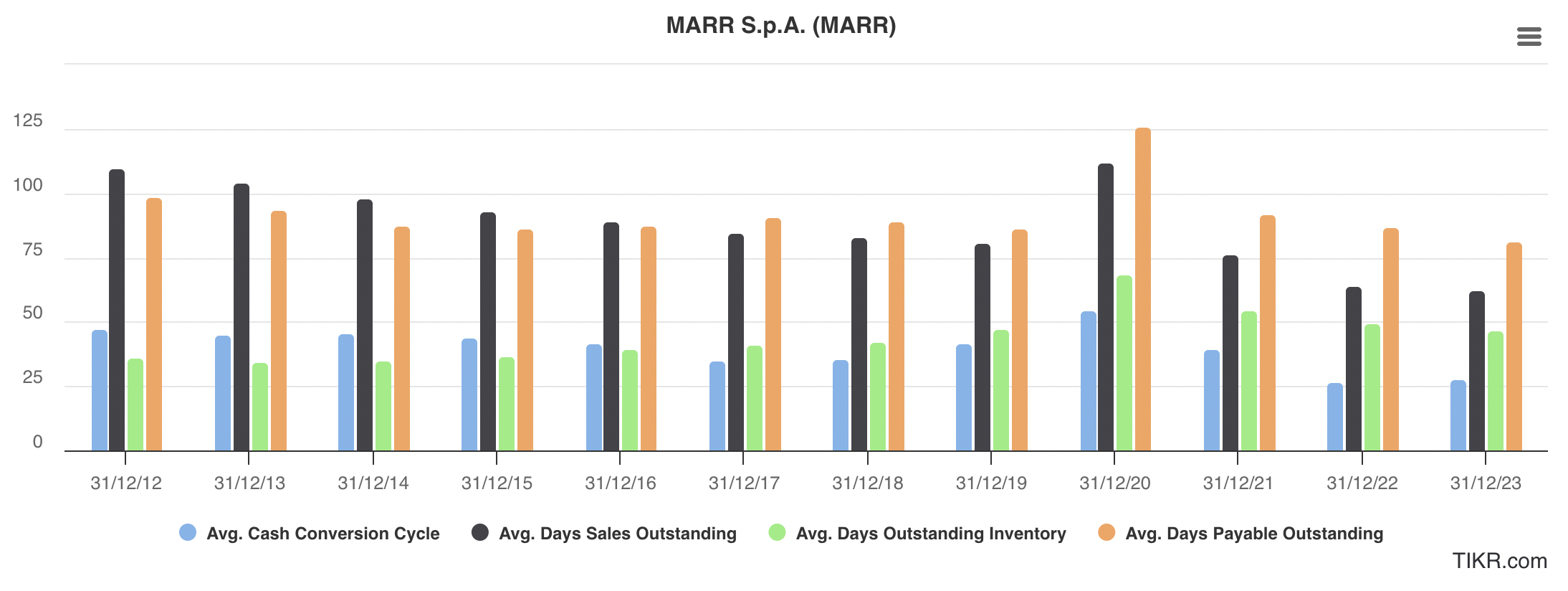
3/ Improvement in cash conversion cycle: it went from 40+ days before Covid to less than 30 during the last 2 years. This reflects the work done on the receivables front mainly: DSO went down from 110 days back in 2012 to 80 days in 2019 and 60 days in 2023
The combination of the 3 makes MARR stronger today than it was before Covid. Management seized this opportunity to invest aggressively for the next few years (€180m over 2024-26) – a clear change from pre-Covid years when capex was €20m max and dividend paid reached €50m. The investment plan aims at improving the operations through the building of 2 platforms and 2 distribution centers – increasing the potential for future organic growth. I expect that move to further improve MARR’s industry positioning and efficiency.
So what do I expect ?
From a topline perspective, MARR has fully recovered from the Covid period and will be able to keep growing at 5% thanks to the structural growth of the market, the market share gains and possibly acquisitions. Due to the size of the current investment plan, I think operating margin won’t reach c7% in the next 3 years. However, I expect the gross margin to fully recover and maybe to expand a bit more – giving a positive impact of 1pt to the operating margin – while addressing issues on the fixed costs front will help the margin in the same proportions.
Overall, I expect revenue in 2026 to be above €2.3bn and margin to reach 6%. This translates into FCF per share of c€1.3 – pre expansion capex. At a conservative 15x FCF, it’s worth €20. Add at least €2 of dividend over the period and total return reaches 100%.

0 Comments